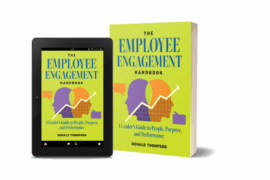
Employee engagement is the engine behind performance, retention, and innovation—without it, even the best strategy will fail. Simply put, engaged employees are a powerful competitive advantage. Yet too many leaders struggle to build workplaces where people feel valued, trusted, and empowered to deliver their best.
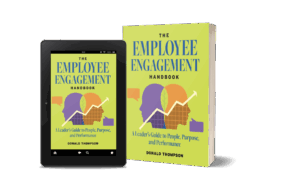 The Employee Engagement Handbook aims to change that. It distills years of research, hard data, and real-world case studies into a practical framework for building human-centered workplaces and high-performing teams.
Below is an exclusive excerpt detailing why employee engagement is a leadership imperative.
Among similar companies, those with motivated, enthusiastic workers simply perform better. Because employee engagement—the emotional connection people feel toward their work, colleagues, and employer—inspires more discretionary effort. “Engaged employees produce better business outcomes than other employees—across industry, company size, and nationality, and in good economic times and bad,” Gallup researchers write.
Yet, despite widespread agreement that engagement drives performance, most organizations are falling short. Gallup’s 2025 State of the Global Workplace survey found that only 21% of employees worldwide report being enthusiastic and engaged about their work. In the United States, just 32% of workers are engaged—a figure that has remained stubbornly stagnant over the past decade. Low engagement is also expensive, costing the global economy US$ 9.6 trillion in lost productivity annually, or 9% of total GDP. For the U.S. economy alone, the estimated cost is $2 trillion a year.
The employee engagement strategies being used by most organizations—if they are implementing strategies at all—are not working. Business leaders need a new framework to address the root causes of disengagement and build workplaces where people and performance thrive.
What Really Drives Employee Engagement
For too long, organizations have relied on transactional solutions—pay raises, bonuses, better benefits, and (often) superficial perks—to solve what is fundamentally a relational and cultural problem. These approaches might improve satisfaction in the short term, but they don’t create sustained engagement.
In fact, one of the most powerful drivers of engagement and performance is meaningful work. Employees who view their work as meaningful are more productive, resilient, and committed to their organization. Additional findings published in Harvard Business Review reveal that 90% of employees are willing to earn less money in exchange for doing meaningful work, some willing to forego up to 23% of their lifetime earnings.
When work feels meaningful, employees put in more effort, collaborate more effectively, and stay longer. Purpose acts as a stabilizer during times of change and disruption, keeping employees connected to the broader goals of the organization. Employees want to understand how their individual efforts contribute to the team, how the team contributes to the business, and how the business contributes to society.
“It’s hard to feel truly invested when you don’t fully understand the company’s mission or how your work drives it forward,” says Karla Sauma, Director of Account Management–Americas at Workplace Options. “When employees feel like their role matters, their work is valued, and they have time to recharge, they bring a renewed sense of purpose and energy that drives lasting impact.”
Employees want to feel seen and heard. They want to work in environments where their contributions matter, their concerns are taken seriously, and their ideas can lead to real change. When those conditions are present, employees engage more fully, take more initiative, and stay focused on results.
The Role of Leaders at Every Level
Leaders must move beyond legacy models that treat engagement as an HR issue or a quarterly metric. Engagement is a daily practice shaped by culture, relationships, and the everyday experiences of employees. From the C-suite to the frontline, every leader, manager, and informal influencer helps shape the employee experience.
C-suite executives and senior leaders set the tone. They define what success looks like, reinforce cultural norms, and model behavior through their decisions and communication. Mid-level and frontline managers translate those expectations into daily interactions, through check-ins, team dynamics, and support for growth. Even informal leaders—individual contributors who influence morale, behavior, or team energy—have the power to boost or erode engagement.
No matter their title, leaders shape how employees feel about their work. That includes whether they feel respected, whether their contributions matter, and whether they can speak up without fear. A culture where employees are heard, trusted, and empowered doesn’t happen by accident.
Whether you’re a newly promoted manager or a seasoned executive, your goal is the same: to foster a workplace where people feel psychologically safe, supported, and motivated to contribute their best work. That means adopting leadership strategies that promote wellbeing, belonging, and purpose—because these are the drivers of engagement, performance, and long-term business success.
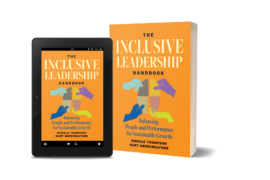
Learn more about building engagement through purpose and connection in The Employee Engagement Handbook: A Leader’s Guide to People, Purpose, and Performance, by Donald Thompson, Managing Director for the Center for Organizational Effectiveness at Workplace Options. This playbook cuts through the noise and focuses on what actually works: inclusive leadership, psychological safety, and people-first strategies that drive employee success and business results.